


Gas fires sit somewhere between a heating appliance and a piece of decor. They're often used seasonally, sometimes for years without a service, and frequently overlooked when the boiler gets its annual attention. That's a mistake — gas fires have specific safety risks that don't apply to a sealed combustion boiler, and those risks compound over time.
Open-flued gas fires (decorative-fuel-effect, inset live-flame, outset radiant — anything that draws air from the room and discharges through the chimney) depend on the chimney pulling correctly. If the flue is partly blocked by debris, a bird's nest, or soot, combustion gases can spill back into the room — including carbon monoxide. The flue draw test using a smoke pellet is the only reliable way to verify the flue is pulling adequately.
Oxygen Depletion Sensors (ODS) are the safety device that shuts a gas fire off if room oxygen drops below safe levels (caused by inadequate ventilation, blocked vents, or extended use in a sealed room). The ODS is tested by procedure during a service — not just visually inspected. Sensors degrade over time and a fire that's been running for years without testing may have an ODS that no longer trips correctly.
Decorative coal/log layouts on DFE fires must be positioned exactly as the manufacturer specifies. Coals or logs in the wrong position alter the flame picture, can cause sooting, and in extreme cases can create CO. The layout is checked at every service.
A proper gas fire service is a structured 45–60 minute procedure (longer for inset live-flame fires with multiple coals to lay, or freestanding fires with covers to remove and reseal). Here's what's covered at every service.
1. Pre-service inspection. Visual condition of the fire — fascia, glass front (if fitted), back-boiler if part of the unit, surround and hearth. Any signs of scorching, sooting, glass cracking, or damage to the gather are noted.
2. Flue draw test. Smoke pellet ignited in the firebox or hearth, smoke draw observed at the gather and into the chimney. A correctly drawing flue pulls the smoke up and away cleanly. A blocked or poorly-drawing flue lets smoke pool or push back into the room — that's a fail and the fire stays off until rectified. The test is repeated after the service to confirm the fire still draws correctly when running.
3. Ventilation check. Room ventilation is verified against the appliance's heat input rating. Rooms with high-rated gas fires (4kW+) typically need an air vent. Vents are inspected to ensure they're not blocked, painted over, or fitted with a draught-cutting cover that defeats their purpose.
4. Burner and injector clean. Fire stripped down to access the burner. Burner ports cleaned of debris, carbon and pet hair. Injector inspected and cleaned where appropriate. Pilot assembly and thermocouple cleaned.
5. Decorative coal/log inspection and repositioning. On DFE fires, every coal or log is removed, inspected for damage, and replaced exactly as the manufacturer's installation manual specifies. Coals or logs that have crumbled, cracked or burned away are replaced (where matching parts are still available — David carries common Valor, Magiglo, Verine and Robinson Willey coals).
6. Gas inlet pressure check. Inlet pressure measured against the manufacturer's working pressure. Low pressure indicates supply problems or restriction; high pressure indicates a regulator fault. Either is investigated before the fire is recommissioned.
7. Light-up and combustion observation. Fire lit, flame picture observed — clean blue base with the appropriate yellow tipping for a decorative live-flame look. Sooting, yellow tipping in wrong areas, or unstable flames are diagnostic of layout, ventilation, or pressure problems.
8. ODS and FFD test. Oxygen depletion sensor tested by procedure — typically by interrupting the pilot flame and verifying the gas valve closes within the manufacturer's specified time. Flame failure device verified to operate correctly.
9. Operational test under load. Fire run on full setting for the manufacturer's prescribed minimum period. Heat output observed, flame stability confirmed across all heat settings.
10. Final flue draw retest. Smoke pellet test repeated with the fire running to confirm the flue continues to draw correctly under combustion conditions.
11. Documentation. Service record completed showing all readings, test results, and any defects identified. Provided to you on completion. Renewal date diaried.
Decorative-fuel-effect (DFE) — the ‘living flame’ gas fire that sits in a chimney breast or gather. Designed to look like a coal or log fire, with decorative ceramic coals or logs positioned over a burner. Open-flued, drawing air from the room and discharging up the chimney. Service includes full coal/log inspection and repositioning, flue draw test with smoke pellet, ODS test, ventilation check.
Inset live-flame — fitted into a wall or chimney breast with a glass front. Sealed combustion or balanced flue typically. Higher heat output than DFE because more of the heat is radiated and convected into the room rather than lost up an open chimney. Service procedure focuses on glass seal integrity, balanced flue terminal, combustion analysis (calibrated flue gas analyser).
Freestanding gas stoves — designed to look like a wood-burner but running on gas. Fitted to a flue liner or twin-wall flue system. Can be open-flued or balanced-flue depending on model. Service covers full appliance strip, flue inspection at terminal and joints, gasket inspection on doors and ash pan.
Outset radiant gas fires — older-style room heaters that sit out from the wall, with radiant elements (often ceramic plaques) that glow when hot. Service focuses on radiant element condition, ODS function, ventilation, and any back-boiler servicing if part of a combined fire/water heating unit.
Hole-in-the-wall (HITW) gas fires — modern frameless gas fires set into a smooth wall opening, often with a stone or steel back. Usually balanced-flue or power-flue. Service covers flue terminal, glass seal, combustion analysis, and decorative bed (pebbles, coals or logs) inspection.
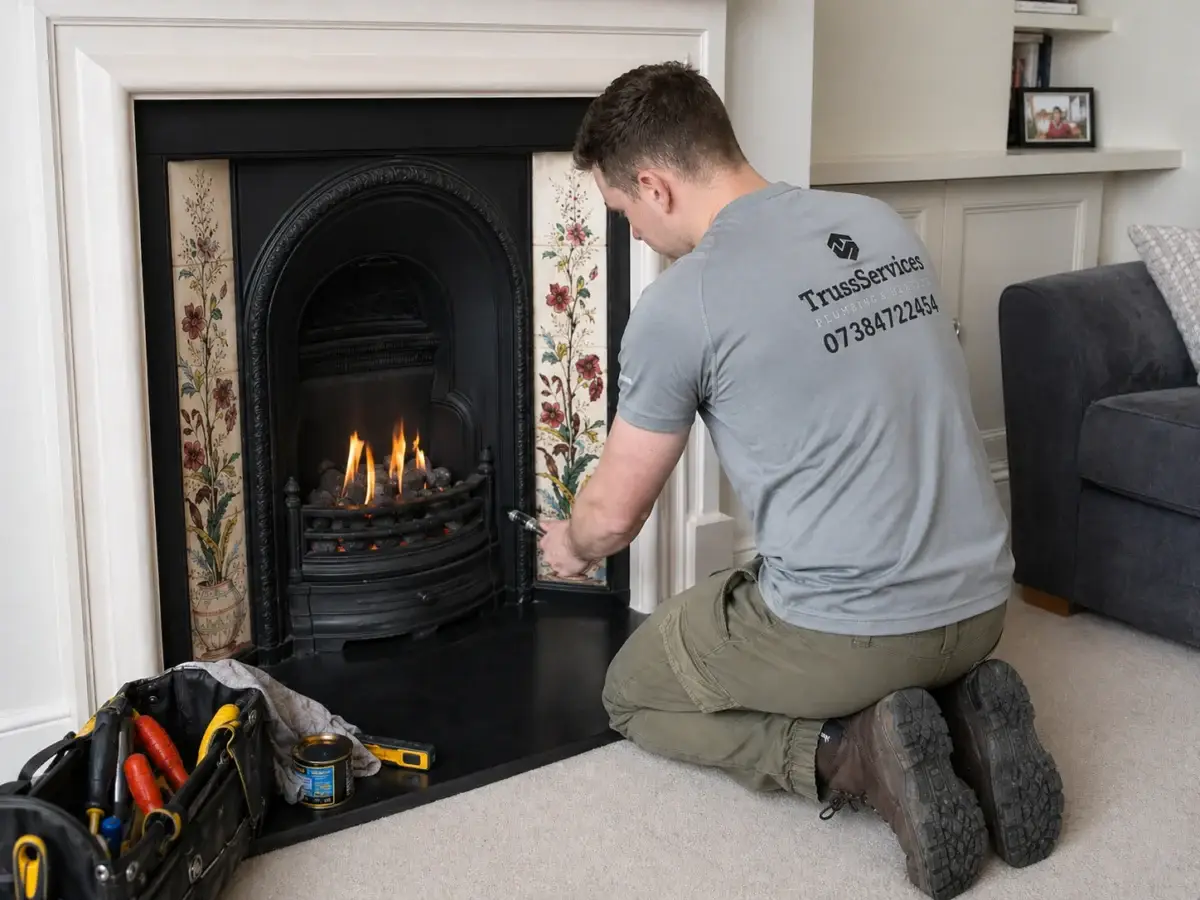

Gas fire faults cluster around a small number of recurring causes. Recognising the symptoms helps both you and David home in on the fault quickly.
Pilot light won't stay lit. Almost always a thermocouple or oxygen depletion sensor fault. Thermocouple replacement is a common service-time job — £45–£75 fitted. ODS replacement is more involved depending on access (£90–£140 typical).
Pilot lights but main burner won't fire. Usually a faulty gas valve, a stuck solenoid, or a wiring fault to the ignition module. Diagnostic test required to identify which. Common Valor, Magiglo and Robinson Willey valves are stocked or available next-day.
Sooting on coals or back of fire. Wrong decorative coal/log positioning is the most common cause. Sometimes inadequate ventilation, sometimes a partially blocked flue. The smoke pellet flue draw test and combustion analysis identify which is at play.
Yellow flame instead of blue base. Indicates rich combustion — too much gas relative to air. Causes: wrong injector, low ventilation, blocked burner ports, or coal layout out of position. Yellow tipping at the top of decorative flames is normal and intentional; yellow flame at the burner base is not.
Pilot light keeps going out under draught. Common in flats and properties with extractor fans on the same level — the extractor pulls air past the pilot and snuffs it. Sometimes needs a draught hood adjustment or a permanent ventilation upgrade.
ODS keeps tripping. Either the ODS itself is faulty (replace), or there's a genuine ventilation problem in the room. The ODS is doing its job by shutting off — investigate the ventilation before assuming the sensor is at fault.
Glass front sooting up (inset/HITW fires). Failed glass seal letting combustion gases past the seal, or wrong burner pressure. Glass replacement and reseal is a manufacturer-specific job; David carries common Verine, Flavel and Gazco glass kits.
David services every major UK domestic gas fire brand. Common parts (thermocouples, ODS units, common pilot assemblies, ignition modules, decorative coal sets) are stocked or available next-day.
Valor — long-running UK brand, strong on DFE inset fires, very common in older Ealing properties. Black Beauty, Homeflame, Trueflame ranges. Coal sets stocked.
Robinson Willey — popular DFE and inset live-flame ranges. Sahara, Firegem, and the older Sapphire and Tahiti models still fitted in plenty of West London properties.
Magiglo — widely fitted live-flame inset fires from the 1990s and 2000s. Coal layouts particularly important — Magiglo was specific about positioning.
Verine — modern HITW and inset live-flame fires with glass fronts. Maestra, Eden, Frontier ranges. Glass kits and gasket sets stocked.
Flavel — DFE and inset live-flame fires. Windsor, Kenilworth, Rocco ranges. Common ignition modules and pilot assemblies.
Be Modern — extensive range of inset, HITW and freestanding fires. Modern range with glass-fronted models. Spares typically available.
Gazco — quality balanced-flue and conventional inset fires, plus freestanding stoves. Logic, Riva, and the Stovax-branded gas stoves.
Other brands — Crystal, Kinder, Eko, Burley, Charlton & Jenrick, Stovax, Dimplex (gas), Yeoman, Pure Vision, Capital Fireplaces and most other UK domestic gas fire brands.

Servicing, repairing or recommissioning a gas fire is regulated work under the Gas Safety (Installation and Use) Regulations 1998. It may only legally be carried out by an engineer registered with the Gas Safe Register. A ‘serviced’ record signed by anyone not on the register is not legally valid, will not satisfy insurance requirements, and provides no genuine assurance the fire is safe.
David is fully Gas Safe registered and carries his ID card on every visit. After every service he provides a written record showing the work carried out, the test results, the gas inlet pressure, the flue draw test outcome, and his Gas Safe registration number. Verify the registration directly at gassaferegister.co.uk by entering David's number.

Annually — same as a boiler. Many people skip it because the fire only runs in winter and feels ‘optional’, but the open flue, the ODS, and the decorative layout all benefit from a yearly inspection. If a fire hasn't been serviced for several years, the first service may take longer because more cleaning is required and decorative coals may need replacing — but after that, annual servicing is straightforward.
£85 for a standard inset DFE or live-flame fire. Freestanding stoves and HITW fires with combustion analysis required £95–£110. Recommissioning a fire that hasn't been used for several years (extra inspection time, more decorative coal handling, possible replacement parts) is typically £110–£140. Any repair parts identified during the service are quoted separately in writing before fitting.
If a defect is found that makes the fire unsafe (failed ODS, blocked flue that won't clear, severe corrosion of the heat exchanger), the fire is turned off and capped with your permission until the defect is rectified. David explains exactly what's wrong and what's needed to put it right. Most failures are repairable — only rarely is a fire genuinely beyond economic repair, and in those cases David tells you straight rather than recommending expensive uneconomic repairs. Gas-side services David also handles: boiler installation, boiler servicing, boiler repair, central heating installation, central heating repair, gas safety checks, gas leak detection, gas cooker installation and power flushing — all Gas Safe registered, all run from the same Ealing base.
If you're planning to use it again — yes, before the first light-up. A long-disused gas fire often has a partially blocked flue (debris, bird nests, soot fall), corroded internal components, decorative coals out of position, and an ODS that hasn't been tested in years. A recommissioning service catches all of those before the fire is fired up. £110–£140 typical for recommissioning. If you're not planning to use the fire again, decommissioning and capping the gas line is a good alternative — £85 typical. Other plumbing work Clive covers from the same Ealing base: emergency plumbing, drain unblocking, pipework and repipes, tap and outlet installation, water tank installation, leak detection, toilet installation, white goods plumbing, kitchen plumbing, radiator installation, hot water cylinder installation and bathroom installation.
Yes — David carries common Valor, Magiglo, Robinson Willey, Verine and Flavel coal and log sets, and can order replacements for less common brands. Worn or broken coals/logs are routinely replaced as part of a service. Cost varies by brand and quantity but a typical full coal replacement is £35–£90 for the parts. Layout is critical — every coal goes back exactly where the manufacturer specifies, not where it ‘looks right’. Other plumbing work Clive covers from the same Ealing base: emergency plumbing, drain unblocking, pipework and repipes, tap and outlet installation, water tank installation, leak detection, toilet installation, white goods plumbing, kitchen plumbing, radiator installation, hot water cylinder installation and bathroom installation.
+
%
+
%

For gas fire servicing and repair anywhere in gas fire servicing in Ealing, gas fire servicing in Acton, gas fire servicing in Hanwell, gas fire servicing in Greenford, Northolt, Perivale, Southall, gas fire servicing in West Ealing, Park Royal, gas fire servicing in Pitshanger, Brentham, North Ealing, gas fire servicing in South Ealing or anywhere else across the W postcodes — phone David directly.
David also covers gas fire servicing across the rest of the borough — gas fire servicing in Boston Manor, gas fire servicing in Brentford, gas fire servicing in Ealing Common and gas fire servicing in Northfields — all served from the same Ealing base, same engineer, same fixed-price quotes.
Standard process: phone call to discuss the fire (make, model, last serviced, any symptoms), service slot booked at a time that works for you. Service record emailed within 24 hours of the visit, paper copy on request. Renewal diaried for next year so you don't forget.