


Thermostatic radiator valves (TRVs) are the small adjustable valves on each radiator that control how much hot water flows through. They wear out over time — typical lifespan is 10–15 years. Symptoms of a failed TRV: radiator stuck on full regardless of valve setting, radiator stays cold no matter how high the valve is turned, valve handle spins freely without engaging anything, valve weeping water at the body or the head.
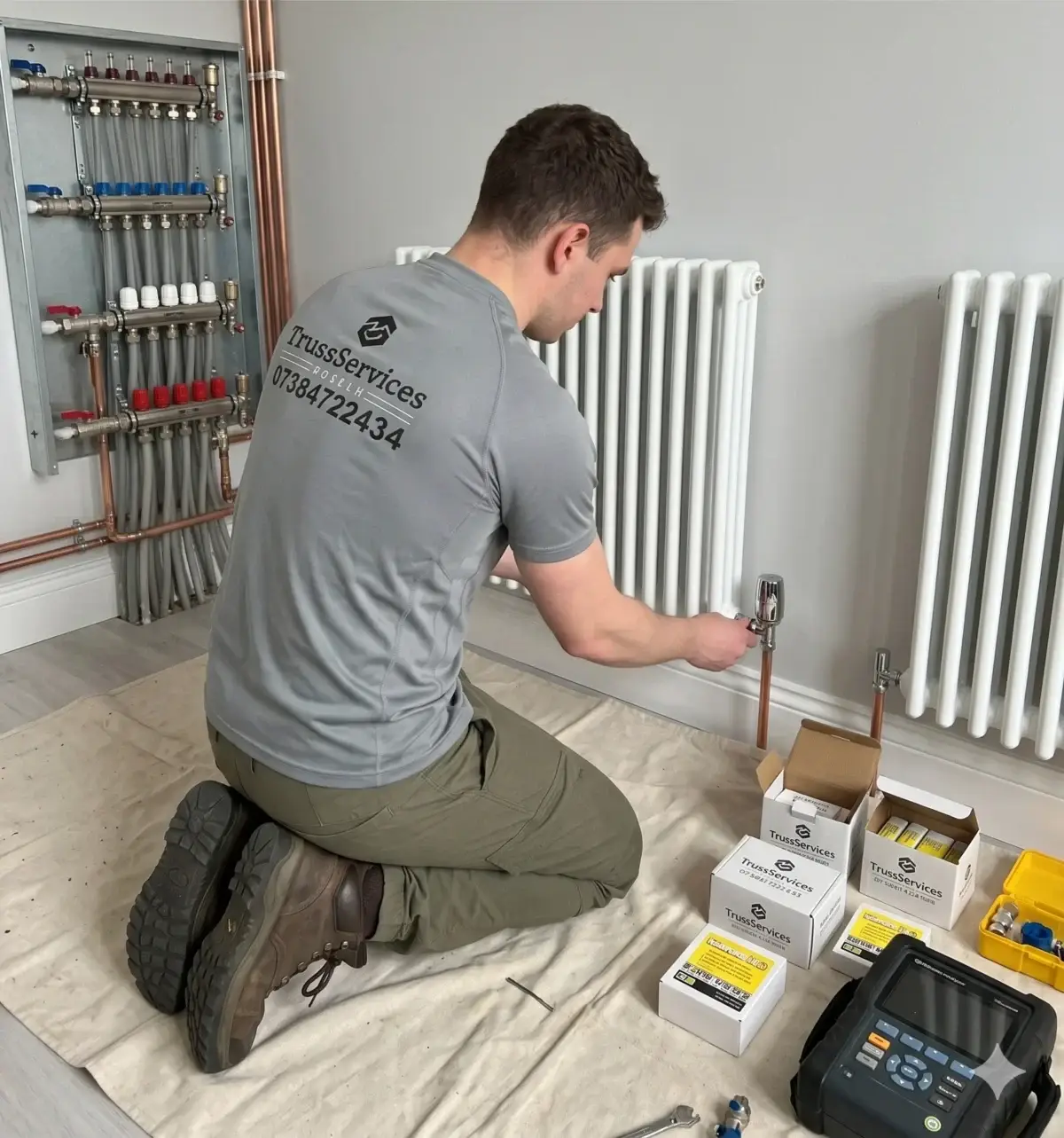
Replacement is straightforward: heating system locally drained at the radiator (not the whole system), old valve unscrewed from the radiator and pipework, new TRV fitted with PTFE tape on the threads, system refilled and bled. Most done in 30–45 minutes. £85–£140 typical including the new TRV.
If multiple TRVs across the property are failing, often worth replacing all of them together — economy of one drain-down rather than several. £45–£75 per additional TRV when done as a batch.
Adding a radiator to an existing heating system is a common request — a new extension needs heating, an underused room is too cold in winter, a kitchen feels chilly when the back door's been opened. Done right, it integrates seamlessly with the existing system. Done wrong, it underheats itself, robs heat from elsewhere, or unbalances the whole system.
Step 1: Sizing. The new radiator's heat output (kW or BTU) must match the room's heat loss. A 4m × 4m kitchen with one external wall and a window needs roughly 2.0kW; a similar bedroom with an external wall and window needs around 1.4kW. Clive uses standard heat-loss calculations rather than guessing — undersized radiators stay on full all winter and never quite warm the room, oversized radiators short-cycle the boiler and waste energy.
Step 2: Connection point. The new radiator needs flow and return pipework connected to the existing heating circuit. Easiest route is usually under a suspended timber floor or via the loft if the boiler is downstairs. Solid floors mean either chasing into the floor (significant disruption) or running pipework along skirting (visually intrusive) — Clive walks through options before committing.
Step 3: System capacity check. Adding a radiator increases the system's water volume and the boiler's heating duty. For one extra radiator on a typical 3-bed semi, this is rarely a problem. For multiple new radiators or a small undersized boiler, the boiler's output capacity needs checking — sometimes the answer is a bigger boiler (David's territory if it's gas-fired).
Step 4: Installation. Heating system drained, new pipework run, new radiator and valves fitted, system refilled with corrosion inhibitor, bled, balanced.
Step 5: System balance. All radiators across the property re-balanced to ensure each gets the right share of flow. Without rebalancing, the new radiator can starve other radiators (or vice versa) — particularly noticeable if upstairs goes cold after a downstairs radiator is added.
Step 6: Commissioning. If anything touches the boiler (pressure adjustment, fresh inhibitor dose at the boiler, system flush) David handles that side because it's Gas Safe registered work. Clive coordinates the timing — typically a 30-minute David visit at the end of a Clive install day.
Typical cost. £350–£650 fitted including the new radiator, valves, pipework run from existing supply, balancing and inhibitor refresh. Premium designer radiators or distant pipework runs add to the cost; quoted in writing on a survey visit.
The standard white panel radiator hasn't gone anywhere — it's still the most heat-efficient and cost-effective option on most properties. But modern radiator design has expanded what's possible, and Ealing properties increasingly use radiators as visual elements as well as heating elements.
Vertical radiators. Tall, narrow units that occupy wall height rather than wall width. Useful in kitchens and bathrooms where horizontal wall space is at a premium but vertical space is available. Heat output per surface area is similar to horizontal units; cost is typically £140–£280 more than the equivalent panel radiator.
Designer panel radiators. Stelrad, Bisque, Hudson Reed and similar brands offer flat-front, double-flat-front, and decorative panel finishes. Cleaner aesthetic than traditional convector panels. Available in custom colours (white, anthracite, chrome, brass) for matching room decor.
Heated towel rails. Standard in modern bathrooms — drying space for towels plus background heat. Connect to the heating circuit via radiator-style flow and return. Available as ladder rails (traditional bars) or designer panels (large flat surfaces). £180–£420 fitted plus the rail itself.
Cast iron column radiators. Period style for Edwardian and Victorian properties. Heavier, slower to heat up but slower to cool down. Significant character. £400–£900+ for a typical 6-section unit fitted, depending on style and finish.
Underfloor heating as alternative. Worth considering for bathroom and kitchen refits — eliminates the wall-mounted radiator entirely, distributes heat more evenly, frees up wall space. Wet UFH connects to the heating system; electric UFH has its own thermostat and sits under tiles. Adds £450–£900 to a refit project; transforms how the room feels in winter.
Radiator cold at the top, hot at the bottom. Air trapped in the radiator. Bleed it via the bleed nipple at the top until water flows steadily. Free fix — but if it keeps recurring, there's air being introduced somewhere (usually a small leak somewhere drawing air on the negative-pressure side of the pump).
Radiator cold at the bottom, hot at the top. Sludge or sediment build-up in the bottom of the radiator blocking flow. Power flush usually fixes it; sometimes the radiator needs replacement if heavily pitted internally. Power flush is gas-side work — David handles the boiler-side commissioning while Clive does the radiator-side flushing.
Radiator stays cold across all of it. No flow getting to the radiator. Causes: stuck TRV (replace it), stuck lockshield valve (free it off or replace), air-lock in the supply pipework (bleed at high points), pump failure (gas-side heating fault — David), or pipework blockage upstream (rare, usually involves significant sludge).
One specific room cold, others fine. Usually system imbalance — that radiator is starved of flow because other radiators on the same loop are over-supplied. Rebalance fixes it: throttle the lockshield valves on the over-supplied radiators slightly, the under-supplied one then gets its share.
Radiator hot but room cold. Radiator undersized for the room. Replacement with a larger unit (more sections on a column, more panels on a flat, larger overall dimensions) fixes it.
Radiator banging or knocking when heating runs. Air in the system, sludge causing flow restriction, or pipework expansion against fixed clips. Bleed first, then power flush if needed. Pipework noise sometimes needs clip relocation.
Visible leak from radiator valve. TRV body weeping (replacement), olive joint at valve weeping (re-make joint with fresh olive), or drain-cock at base of system weeping (close fully, sometimes replace).
Heating system rebalancing is the calibration step that ensures every radiator gets its correct share of hot water flow. Without rebalancing, even a perfectly-installed system has cold rooms and over-warm rooms because the flow naturally favours the path of least resistance — usually the radiators closest to the boiler.
The lockshield valve on each radiator (the small plain valve on the opposite end from the TRV) is the calibration tool. By throttling these slightly, flow is redirected away from radiators that don't need it and toward ones that do.
Standard rebalance procedure. System brought up to operating temperature with all TRVs fully open. Flow temperature measured at each radiator inlet, return temperature at each radiator outlet. Difference between the two (the ‘temperature drop’) should be roughly 11°C across each radiator at design conditions. Lockshields adjusted iteratively until each radiator achieves the target drop — radiators with too small a drop (over-supplied) get throttled, radiators with too big a drop (under-supplied) get opened up. Typically 60–90 minutes for a 3-bed semi.
Why most systems aren't balanced. Time and cost. Rebalancing properly takes 60–90 minutes per system, and most installers don't do it as standard on radiator swaps because it's not always invoiced separately. The result is systems that work but waste energy and have cold rooms — the boiler runs harder and longer than it needs to, with one warm room and one cold room.
When rebalancing is most needed. After any radiator addition, removal or replacement. After any pipework alteration to the heating circuit. After any pump or valve change. As an annual check on systems that have been adjusted incrementally over years (often picking up old imbalances accumulated from incremental work).
Typical cost. £140–£220 for a full system rebalance on a typical 3-bed property. Often included as part of larger radiator work at no extra charge.

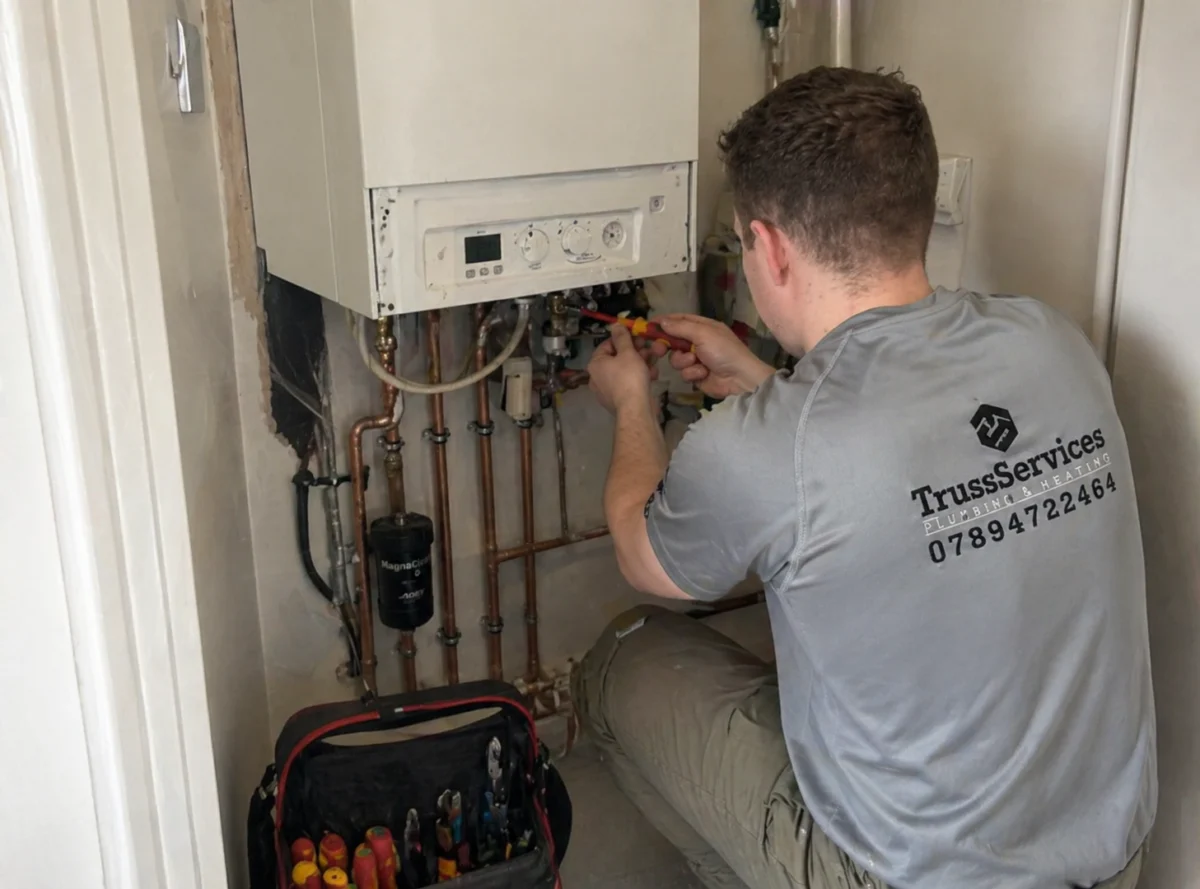
Anything that touches the boiler — system pressure adjustments, commissioning checks, power flush boiler-side connections, magnetic filter at boiler position, new zone valve commissioning, pump replacement at the boiler — is Gas Safe registered work. Clive isn't Gas Safe registered, so for any radiator project that affects the boiler, David handles the gas-side commissioning. David is fully Gas Safe registered (registration verifiable at gassaferegister.co.uk) with twenty-plus years of West London boiler experience. Coordinated visits — typically a 30-minute David call-in at the end of a Clive install day — ensure the whole project is properly covered.

£180–£350 for a like-for-like radiator swap including the new radiator, new TRV and lockshield, refilling, bleeding and rebalancing. £350–£650 for adding a new radiator to an existing system (sizing calculation, pipework run, balancing). £400–£900+ for designer or cast iron column radiators (premium units). All quoted as fixed prices including labour and standard fittings.
Diagnostic depends on which part is cold. Cold at the top, hot at the bottom = air trapped, free DIY fix by bleeding. Cold at the bottom, hot at the top = sludge build-up, needs power flush. Cold across all of it = no flow, usually a stuck TRV (£85–£140 to replace) or system imbalance (£140–£220 to rebalance). Phone Clive on 07794 400 786 to triage — most causes narrowable from a quick description.
Smart TRVs replace the standard mechanical TRV head with an electronic one that can be controlled from a phone or central hub. Plumbing-side fit is identical to a standard TRV (£85–£140 fitted) plus the cost of the smart head. The hub setup and phone-app pairing is owner-side work — Clive walks through the basics but doesn't do extensive smart-home configuration. Worth fitting if you'll actually use the room-by-room control; not worth fitting if you'll set them all to one temperature and forget. Other plumbing work Clive covers from the same Ealing base: emergency plumbing, drain unblocking, pipework and repipes, tap and outlet installation, water tank installation, leak detection, toilet installation, white goods plumbing, kitchen plumbing, hot water cylinder installation and bathroom installation.
For most single-radiator work, nothing — Clive handles it end-to-end on the plumbing side without the boiler being touched. For larger projects where the boiler is affected (new radiator load needing system pressure adjustment, power flush touching the boiler, system commissioning after major work), David handles the gas-registered side. Standard pattern: Clive does the radiator install during the day, David visits at the end for a 30-minute commissioning check. You don't pay extra for the coordination — it's just how the project is properly run. Other plumbing work Clive covers from the same Ealing base: emergency plumbing, drain unblocking, tap and outlet installation, water tank installation, leak detection, toilet installation, white goods plumbing, kitchen plumbing, hot water cylinder installation and bathroom installation.
+
%
+
%

For radiator installation, repair and system rebalancing work anywhere in radiator installation in Ealing, radiator installation in Acton, radiator installation in Hanwell, radiator installation in Greenford, Northolt, Perivale, Southall, radiator installation in West Ealing, Park Royal, radiator installation in Pitshanger, Brentham, North Ealing, radiator installation in South Ealing or anywhere else across the W postcodes — phone Clive directly on 07794 400 786 for plumbing-side enquiries.
Clive also covers radiator installation across the rest of the borough — radiator installation in Boston Manor, radiator installation in Brentford, radiator installation in Ealing Common and radiator installation in Northfields — all served from the same Ealing base, same engineer, same fixed-price quotes.
Standard process: phone call to triage symptoms, on-site survey for installation work, plumbing-side handled by Clive end-to-end, David coordinated for any gas-registered commissioning. Single TRV swaps booked within a few days; larger installations quoted in writing after a survey visit.