

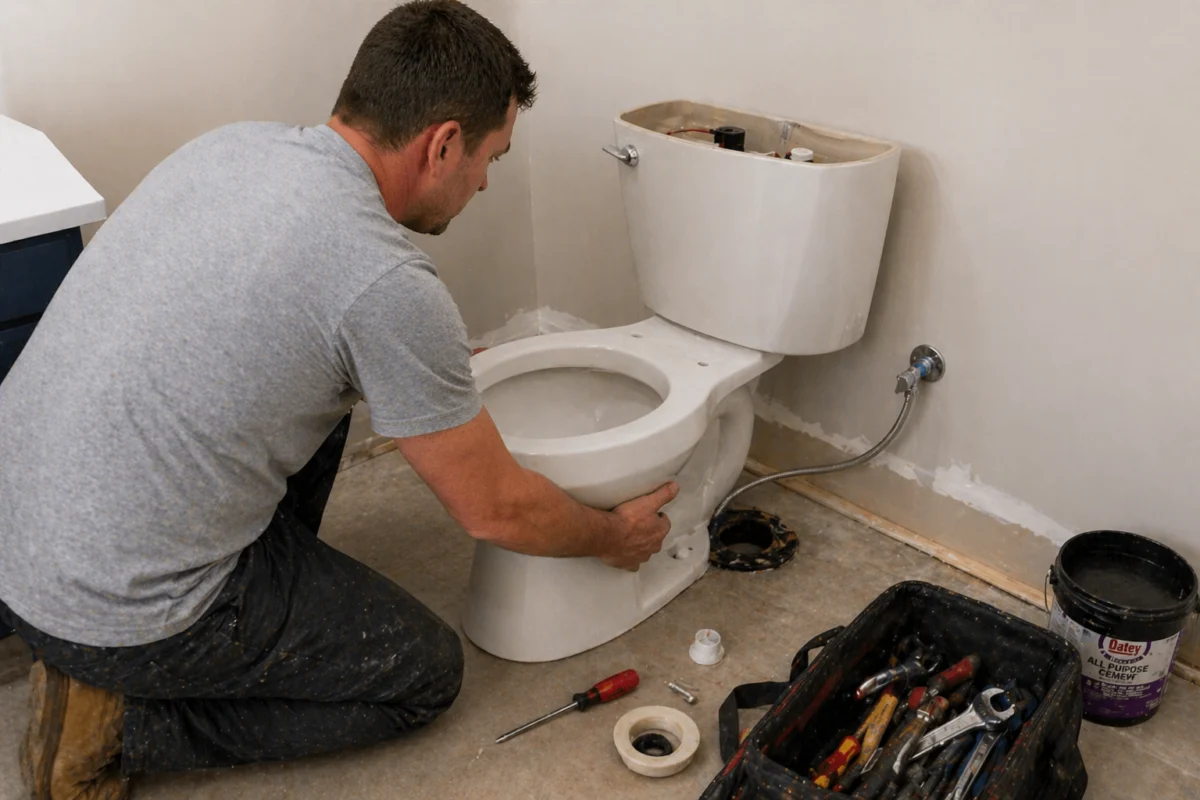
Close-coupled toilets are the standard — a pan with a cistern bolted directly to its back. Single visible unit, simple to install, simple to service, no concealed components. Best for traditional bathrooms and refit projects on a tight budget. £180–£260 fitted including disposal.
Back-to-wall toilets have the pan visible with the cistern hidden inside a unit or boxed-in to the wall behind. Tidier appearance than close-coupled, slightly more involved install (cistern access via a flush plate). The cistern is usually a Geberit or Grohe in-wall frame. £280–£420 fitted plus the unit and frame.
Wall-hung toilets have the pan suspended from a metal frame inside the wall, no floor contact at all. Cleanest look, easiest floor cleaning, more expensive install. Requires a Geberit Duofix or equivalent in-wall frame fixed into the wall structure (or to a stud wall built specifically to take the load). £450–£650 fitted plus the unit and frame.
Macerator-pumped toilets are used where there's no gravity-fed soil pipe access — typically en-suites added in awkward locations (under stairs, in basements, in extensions where the original soil stack is far away). The toilet pan flushes into a small electric macerator unit that pulps the waste and pumps it through small-bore pipework to the existing soil stack. SaniFlo, Saniaccess, Saniplus and similar. More servicing required than gravity-fed toilets, but make impossible toilet locations possible. £450–£750 fitted plus the macerator unit.
Replacing a like-for-like close-coupled toilet on an existing soil pipe connection is a 90-minute job. The reason some installs take longer is what's around the toilet — old soil-pipe sealing, awkward access, levelling on uneven floors, water-supply isolation issues. Here's the structured approach.
Step 1: Isolation and drain. Cold supply isolated at the cistern's service valve (small valve on the supply pipe behind or below the cistern). If there's no service valve fitted (common on older installs), one is added as part of the job. Cistern flushed empty. Pan flushed to clear standing water.
Step 2: Old toilet removal. Cistern unscrewed from pan, pan unbolted from floor, soil pipe connection broken. Old unit lifted out. Soil pipe socket inspected — sometimes the rubber connector needs replacement, sometimes the soil pipe rim needs cleaning back to clean plastic.
Step 3: Floor preparation. Old sealant residue cleaned from floor. Tile or floor levelled if there's any rocking. New fixing holes drilled if the new pan footprint differs from the old one. Original holes filled and tidied if not reused.
Step 4: New toilet positioning. Pan offered up to soil pipe socket with new connector if needed. Pan levelled — shims used if floor is uneven. Position confirmed before any fixings go in.
Step 5: Pan fixing. Pan secured to floor through pre-existing or new bolt holes. Sealant around the base — silicone for hygiene rather than grip (silicone allows the pan to be removed cleanly later, grip-adhesive doesn't). For wall-hung and back-to-wall, additional fixings to the wall frame.
Step 6: Cistern fitting. Cistern bolted to the pan (close-coupled) or to the in-wall frame (back-to-wall, wall-hung). New rubber doughnut between pan and cistern (always — old ones leak). New cistern bolts with rubber sealing washers.
Step 7: Internal mechanism. Fill valve and flush valve fitted inside the cistern. Modern toilets typically have dual-flush valves (3/6 litre or 4/6 litre split). Float arm levelled to set water level correctly.
Step 8: Connection and seat. Cold supply reconnected to fill valve. Toilet seat fitted to the pan. Seat hinges adjusted for level closing.
Step 9: Test cycle. Service valve opened, cistern fills, fill valve cuts off cleanly at correct level. Test flush — full flush should clear standing water and refill smoothly. Half-flush should release lower volume cleanly. Multiple flushes to verify the seal at every joint.
Step 10: Walk-through and disposal. Old toilet removed and disposed of. New toilet's manual handed over. Maintenance advice given (especially for dual-flush mechanisms). Clean job site.
Toilet won't stop running. Water continuously trickling from the cistern into the pan. Cause is almost always a failed flush valve seal or a stuck fill valve that's overfilling and overflowing through the flush-valve hole. New flush valve £20–£40 fitted; new fill valve £25–£50. Usually 30–45 minutes including diagnosis.
Toilet won't flush properly. Weak flush, partial flush, no flush. Cause varies: failed flush mechanism (handle disconnected from valve), partially blocked flush rim (limescale build-up), low water level in cistern, or something stuck in the trap. Different fixes for each — diagnosed during the visit, fixed same-visit where parts are stocked.
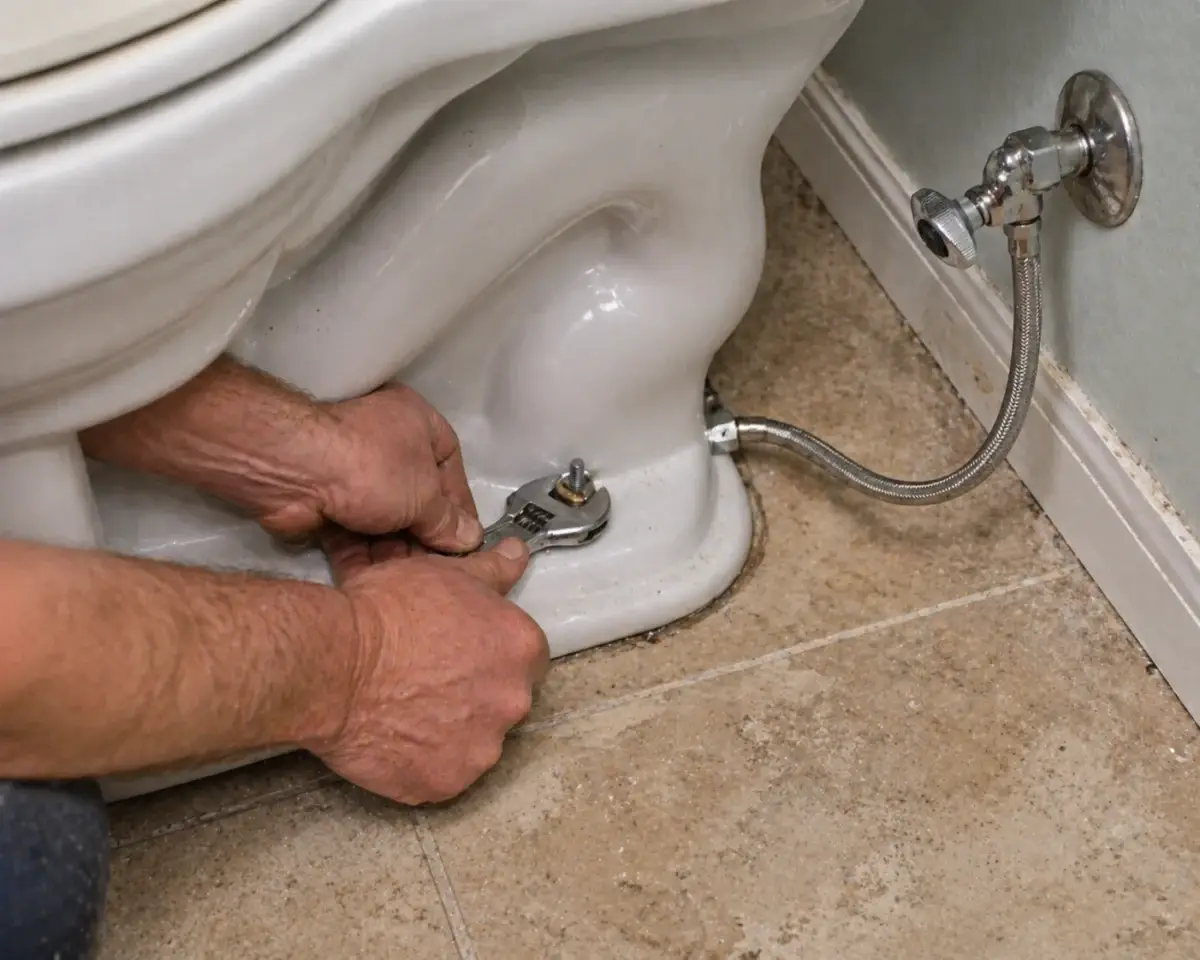
Toilet leaking at the base. Water on the floor around the pan. Cause: failed wax ring or rubber seal between the pan outlet and the soil pipe. Pan removed, old seal cleaned off, new seal fitted, pan re-set with fresh sealant. £140–£220 typical including parts.
Toilet leaking between cistern and pan. Water visible at the joint between cistern and pan body. Cause: perished rubber doughnut seal between cistern and pan, or failed cistern bolts/sealing washers. Cistern lifted off, all sealing components renewed, refit and test. £85–£140 typical.
Cracked toilet pan. Visible crack in the porcelain, sometimes leaking and sometimes not. Cracks aren't repairable on a pan — replacement is the only option. Like-for-like swap £180–£260.
Stuck or broken flush handle. Handle won't depress, lifts off the cistern when pulled, or doesn't return to position. New handle and link mechanism £15–£35 fitted. 30 minutes typical.
Cistern fills slowly. Cause: clogged inlet on the fill valve (limescale build-up) or partially closed service valve. Cleaned out or full fill-valve replacement. £45–£90 typical.

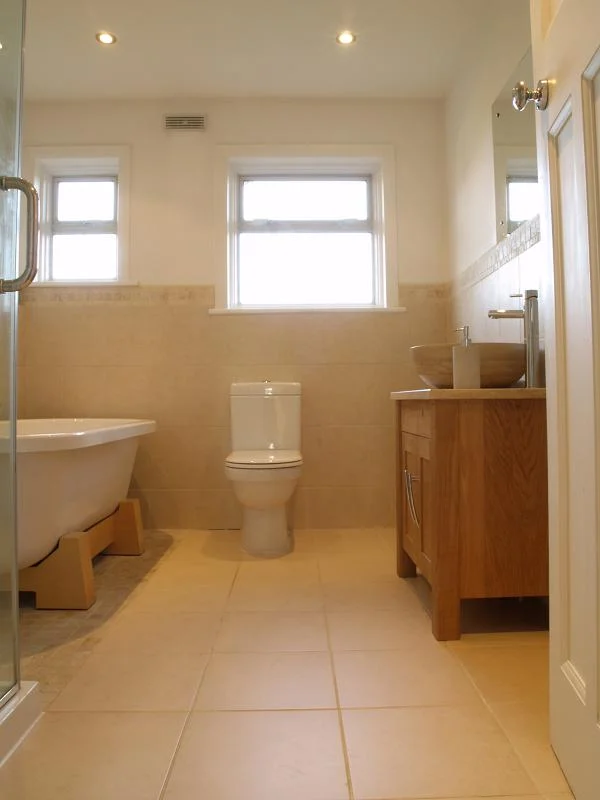
Macerator-pumped toilets (SaniFlo, Saniaccess, Saniplus, etc) make toilet installation possible in locations where a gravity-fed soil pipe simply can't reach — under-stair en-suites, basement bathrooms, extension cloakrooms, top-floor loft conversions where the soil stack is far below.
How they work. A small electric macerator unit sits behind or beside the toilet pan. When the toilet flushes, the waste enters the macerator which has internal blades that pulp it into a slurry. A pump then pushes the slurry through small-bore pipework (usually 22mm or 28mm rather than the 110mm of a gravity soil pipe) to the existing soil stack — vertically up to several metres if needed, or horizontally over significant distances.
Where they work well. Locations with no gravity soil-stack access. Where the alternative is digging up floors and walls to install a 110mm soil pipe (often impossibly disruptive and sometimes structurally not possible). Where occasional use is fine.
Where they need careful sizing. Family bathrooms with high daily use — macerators have duty cycles and aren't designed for constant heavy use. A second toilet on a property is usually fine; replacing the only toilet with a macerator is rarely advised.
Servicing requirements. Macerators need annual service to descale the macerator chamber and check the pump. They have a finite life (10–15 years typically) versus gravity toilets that effectively last forever. Every macerator-fed bathroom should also have a non-macerator alternative if at all possible.
What can and can't go in. Toilet paper and waste only. No wipes, no sanitary products, no kitchen waste, no chemical cleaners. Macerators block much faster than gravity systems if the wrong things go in.
Clive installs all major macerator brands — SaniFlo, Saniaccess, Saniplus, Saniwall, Sanibest. Quoted on survey: typical £450–£750 fitted plus the macerator unit and any pipework run.
Toilet pricing varies depending on what's involved. Here's a realistic guide based on recent Clive jobs across West London:
Single component repair — fill valve, flush valve, handle, doughnut seal — £45–£140 fitted. Most done in 30–60 minutes including diagnosis.
Like-for-like close-coupled toilet swap — £180–£260 fitted including disposal of the old unit. Typical 90-minute job. Add £45 if a service valve isn't already fitted on the supply.
Back-to-wall toilet install — £280–£420 fitted plus the unit and in-wall frame. 3–4 hours typical including frame fitting and tile-back-on (if access through tiled wall).
Wall-hung toilet install — £450–£650 fitted plus the unit and Geberit/Grohe Duofix frame. 4–6 hours typical including structural frame fixing. Often part of a refit because the wall has to be opened up anyway.
Macerator-pumped toilet install — £450–£750 fitted plus the macerator unit and small-bore pipework run. Quoted on survey because the pipework run distance significantly affects cost.
Concealed cistern repair — repairing internal components inside an in-wall frame via the flush plate access opening. £85–£180 typical depending on the part.
Soil pipe extension — extending or modifying the existing soil pipe to accommodate a new toilet position. Quoted on survey, typically £180–£420 depending on access.
All prices are fixed quotes, not hourly. No minimum charge. No surprise extras.
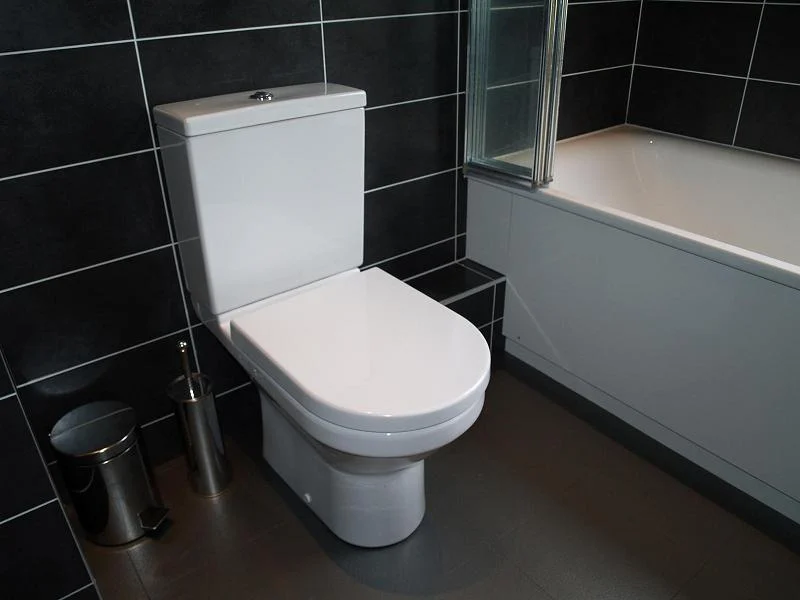
£180–£260 for a like-for-like close-coupled toilet swap including disposal of the old unit and full leak test. £280–£420 for back-to-wall installations. £450–£650 for wall-hung. £450–£750 for macerator-pumped. All prices are fixed quotes including labour and standard fittings; the toilet unit itself is separate (you supply, or Clive can source). No minimum charge, no hourly billing. Other plumbing work Clive covers from the same Ealing base: emergency plumbing, drain unblocking, pipework and repipes, tap and outlet installation, water tank installation, leak detection, white goods plumbing, kitchen plumbing, radiator installation, hot water cylinder installation and bathroom installation.
Like-for-like close-coupled swap: 90 minutes typical. Back-to-wall: 3–4 hours. Wall-hung: 4–6 hours. Macerator-pumped: 4–8 hours depending on pipework run. Concealed-cistern installations are longer because of the in-wall frame fitting; usually a half-day or full day. Single repairs (fill valve, flush valve, etc) are 30–60 minutes typical.
Almost always a failed flush valve or a stuck fill valve. The flush valve sits at the bottom of the cistern and seals the outlet to the pan; when it fails, water trickles continuously into the pan. The fill valve sits on the cold supply inlet and shuts off when the cistern is full; when it fails or sticks, the cistern overfills and overflows through the flush valve hole. Either part is £20–£50 fitted. Both are 30–60 minute jobs. The water bill saving from fixing it usually pays for the repair within months on metered properties. Other plumbing work Clive covers from the same Ealing base: emergency plumbing, tap and outlet installation, water tank installation, leak detection, white goods plumbing, kitchen plumbing, radiator installation, hot water cylinder installation and bathroom installation.
Yes — most clients do exactly that. Clive's fee is the labour and any small materials needed (sealant, doughnut seal, fixing bolts, service valve if not already fitted). Bring the toilet to the appointment with the manufacturer's manual. Clive can advise before you order if you're not sure whether a particular toilet suits your existing soil-pipe position — phone with the model name before purchasing. Gas-side services David also handles: boiler installation, boiler servicing, boiler repair, central heating installation, central heating repair, gas safety checks, gas leak detection, gas cooker installation, gas fire servicing and power flushing — all Gas Safe registered, all run from the same Ealing base.
Yes — comfort-height toilets (raised pan height for easier sitting and standing), wall-mounted grab rails, lever flush handles for limited-grip users, wider doors for wheelchair access if part of a refit. Coordinated with the rest of the bathroom adaptation work. Worth checking eligibility for council disabled-facilities grants which sometimes cover the cost.
+
%
+
%
For toilet installation and repair work anywhere in toilet installation in Ealing, toilet installation in Acton, toilet installation in Hanwell, toilet installation in Greenford, Northolt, Perivale, Southall, toilet installation in West Ealing, Park Royal, toilet installation in Pitshanger, Brentham, North Ealing, toilet installation in South Ealing or anywhere else across the W postcodes — phone Clive directly on 07794 400 786.
Clive also covers toilet installation across the rest of the borough — toilet installation in Boston Manor, toilet installation in Brentford, toilet installation in Ealing Common and toilet installation in Northfields — all served from the same Ealing base, same engineer, same fixed-price quotes.
Single repairs typically booked within a few days. Toilet replacements quoted on the phone if you describe the existing setup, or via a free survey for back-to-wall, wall-hung and macerator installs. 12-month workmanship warranty on every installation.