

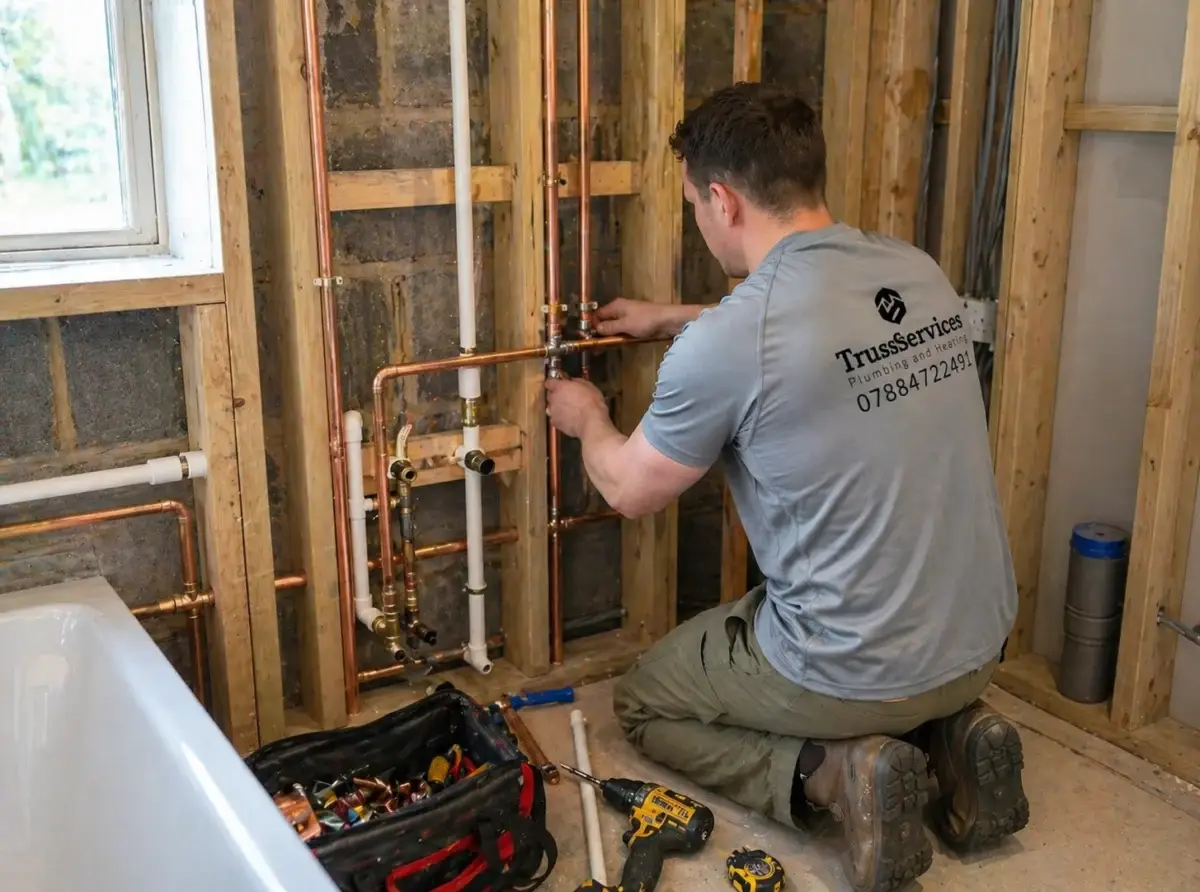
Original pipework in older Ealing properties is often original. That sounds obvious until you do the maths: copper pipework installed in the 1960s is now 60+ years old. Galvanised steel pipework from before the 1960s is older still. Lead supply pipes — common in pre-1970s properties — are older yet, and increasingly a regulatory issue.
Pipework doesn't last forever. Symptoms of end-of-life are progressive: occasional weeping at compression joints, copper turning blue-green at fittings, low flow at upstairs taps (mains pressure dropping through restricted runs), discoloured water in the morning (build-up flushing through), recurring leaks in the same areas of the house. Each individual symptom feels manageable; collectively they signal that the system is reaching the end of its working life.
The economic case for staged repipes typically outweighs spot-repairing forever. After three or four leak callouts in two years, repeated decoration repair, and the rising risk of a hidden leak causing major water damage, replacing the run rather than the joint becomes the cheaper path.
Lead pipework was standard for water supply across the UK from Victorian times until the 1970s. It's still in tens of thousands of older properties across Ealing and West London. There are two reasons it now warrants attention.
Health. Lead leaches into water sitting in the pipe overnight, particularly in soft-water areas. Modern public-health guidance is that there is no completely safe level of lead in drinking water. Children and pregnant women are particularly vulnerable. Running the tap for a minute before drinking after a long stand reduces but doesn't eliminate the issue. The reliable answer is to replace lead supply pipework with modern MDPE or copper.
Regulatory and resale. Buildings surveys increasingly flag lead supply pipework as a defect. Some lenders are restricting mortgage offers on properties with lead supply still in place. New supplies installed by Thames Water are MDPE; their preference (and increasingly their condition for new connections) is for the property side to be replaced too.
What replacement involves. The lead pipe usually runs from the Thames Water boundary stopcock (in the pavement) to the property's internal stopcock (often under the kitchen sink). For a typical Ealing terrace that's 2–8 metres of buried pipe — sometimes through a front garden, sometimes under a path or driveway. The new pipe (25mm MDPE for most domestic supplies) is laid through a mole-bore (no-dig route) where ground conditions allow, or through a trench dug along the existing route. New stopcock fitted, system tested, water sample taken to confirm flow and quality.
Funded support. Thames Water's Lead Pipe Replacement Programme sometimes contributes to or fully funds replacement of the property's side of the lead supply, particularly when they're working in the area replacing their side. Clive checks the latest eligibility criteria before any chargeable work is quoted — you may not have to pay for any of it.
Internal lead pipework. Beyond the supply pipe, some properties also have internal lead pipework feeding cold tanks or hot cylinders. That's a separate replacement project — usually done as part of a bathroom or kitchen refit because the runs are typically inside walls and floors that need opening up anyway.
Copper remains the gold standard for visible runs and where heat is involved. Soldered or compression jointed, holds pressure indefinitely if installed properly, immune to UV, fire-resistant. The downside: more expensive in materials, slower to install, requires soldering skill on capillary fittings. Clive uses copper for boiler primaries, exposed runs in plant rooms and airing cupboards, and any run where future visibility matters.
Push-fit plastic (Hep2O, Speedfit, etc) is the modern workhorse for hidden domestic pipework. Faster to install than copper, can be threaded through joists and walls more easily, no soldering. Manufacturer warranties are typically 25–50 years on properly-installed systems. Used for cold mains runs, hot supply runs to fixtures, and most central heating drops. Limitation: cannot be installed within 1m of a boiler (heat tolerance), so the last metre or so to any boiler is always copper.
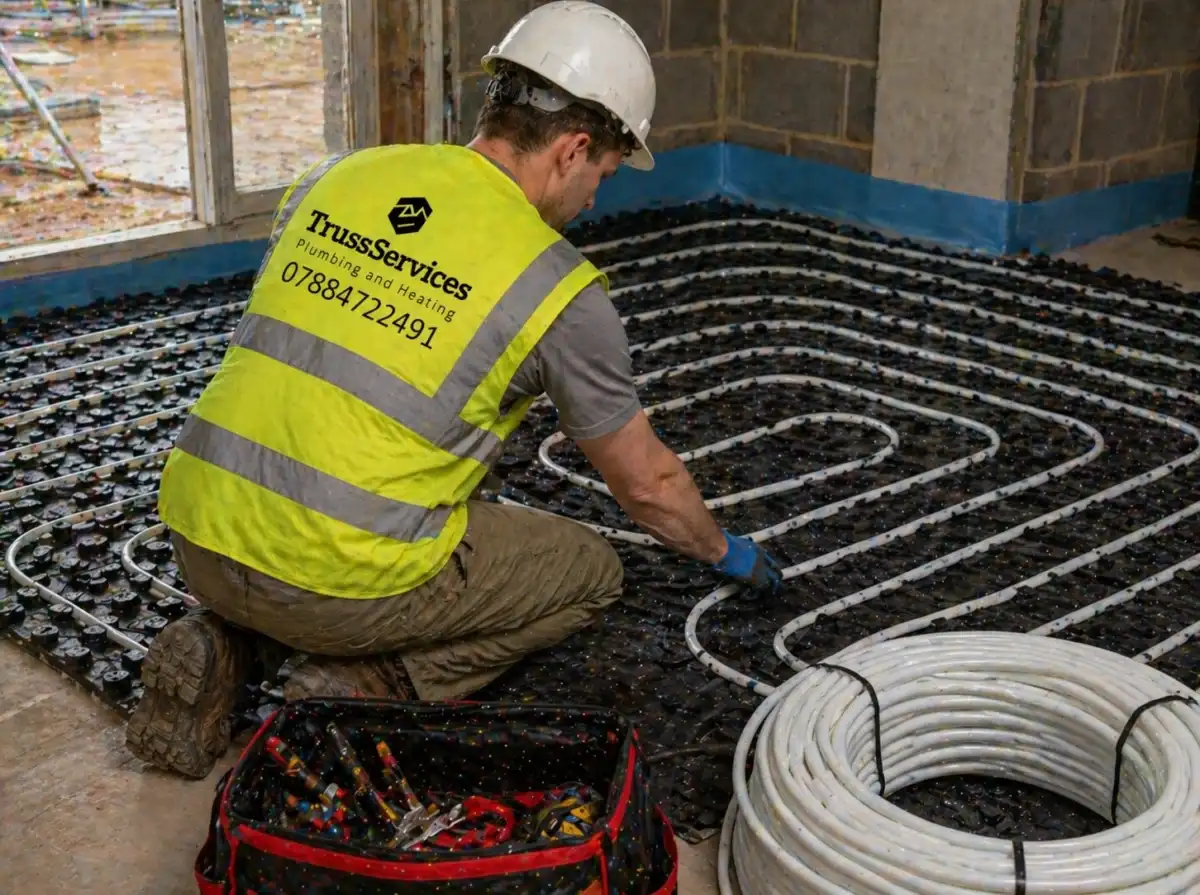
Multilayer (MLCP — multilayer composite pipe, e.g. Uponor) is the premium choice for renovations. Aluminium core sandwiched between PEX layers — combines plastic's flexibility with metal's dimensional stability. Used for underfloor heating loops, exposed runs in design-led installations, and properties where future-proofing matters. More expensive than push-fit plastic; comparable to copper in materials cost.
MDPE (medium-density polyethylene, blue) is the standard for buried external supply runs. Replaces lead as the supply pipe between Thames Water boundary and property internal stopcock. Continuous-roll, no joints buried underground, 50+ year design life.

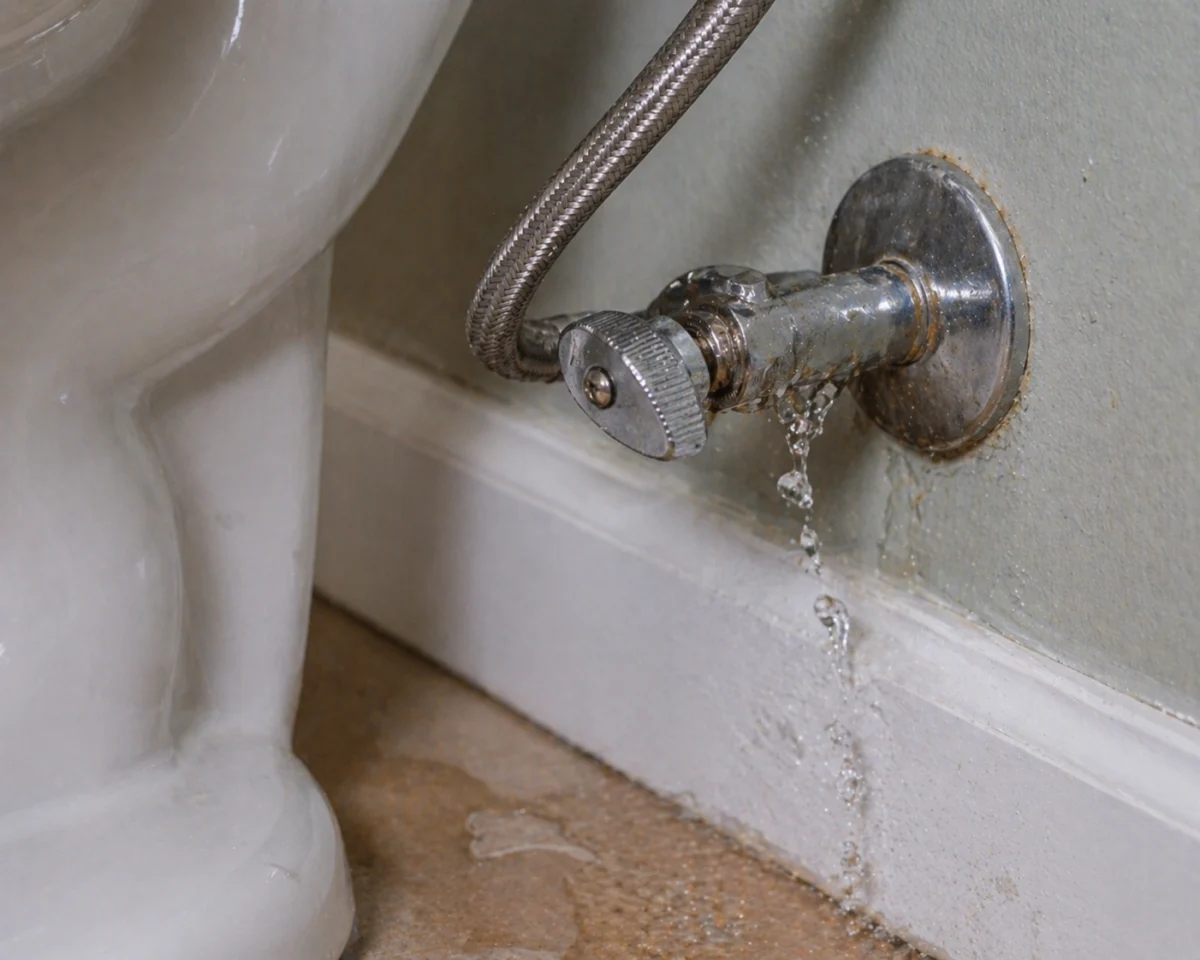
Sometimes a property doesn't need a full repipe — it just has a hidden leak that's masquerading as one. Symptoms can look identical: pressure dropping, recurring damp patches, water bills creeping up, occasional gurgling in pipework. The right response is to trace the leak first, then decide on scope.
Acoustic leak detection. Sensitive microphone equipment placed at strategic points around the system. Water escaping from a pressurised pipe makes a characteristic high-frequency hiss — the equipment localises the source to within 30–50cm even through walls, floors and concrete.
Pressure isolation testing. Sections of the system isolated and pressure-tested individually. The section that loses pressure contains the leak; sections that hold pressure are clear. Useful for narrowing down which run to acoustic-test first.
Thermographic imaging. Hot water leaks show up clearly on thermal imaging — heat radiates from the leak source. Cold water leaks are subtler but visible if the water is significantly cooler than ambient (often the case with mains supply).
Trace-and-access work. Once the leak is localised, access is opened up minimally — typically a 30cm × 30cm panel cut into a wall or ceiling — and the leak source confirmed visually. Repair then made (usually a single joint or a 1m section of pipe), pressure-tested, and the access panel reinstated.
Insurance documentation. Most buildings insurance covers trace-and-access for hidden leaks. Clive provides full written documentation — leak location, repair carried out, before/after readings — exactly what insurers expect for claims.
If your shower runs weak when the kitchen tap is on, your upstairs taps trickle when the washing machine fills, or your combi boiler can't supply two hot taps simultaneously, the cause is usually flow restriction rather than mains pressure. The mains pressure is fine; the 15mm pipework is choking the flow before it can reach the fixtures that demand it.
Older Ealing properties commonly have a 15mm copper or galvanised steel rising main running from the under-sink stopcock to the rest of the system. That's adequate for low-demand single-bathroom properties. It struggles in homes with combi boilers serving multiple fixtures, multi-bathroom households, or modern showers that demand 12+ litres per minute.
The fix is upgrading the rising main to 22mm copper or MDPE — the difference in flow rate is dramatic (a 22mm pipe carries roughly twice the flow of a 15mm at the same pressure). Sometimes the upgrade extends to 28mm for properties with high simultaneous demand.
Typical scope: stopcock upgrade if the existing one is undersized, rising main replaced from stopcock to first major branch (often the airing cupboard or boiler position), branches off to bathrooms either reused (if 22mm already) or upsized. Most done in 1–2 days. £450–£950 typical for the rising main upgrade alone.

For a typical 3-bed Ealing semi, expect £4,500–£7,500 for hot and cold repipes (excluding heating system). For a full system replacement including heating drops to all radiators, £7,000–£11,000. Premium renovations using multilayer composite pipe and significant access work can run £12,000+. Lead supply pipework replacement is typically £600–£1,200 (sometimes free under Thames Water's programme). Every quote is itemised — every metre, every fitting, every day of labour.
Yes — that's the standard approach. Clive sequences the work room by room with the water off only briefly when actually swapping over runs. Bathroom first (typically 1 day's water-off in the bathroom), then kitchen (1 day's water-off in the kitchen), then heating circuit (1–2 days' heating off, hot water managed via cylinder if applicable). Most repipes are completed over 5–10 days with the property fully usable in between work segments.
Clive isn't a Thames Water contractor, but he's done plenty of property-side lead replacements alongside Thames Water's boundary-side work. The standard pattern: Thames Water replaces from main to boundary stopcock (free); Clive replaces from boundary to property internal stopcock (sometimes funded by Thames, sometimes paid by you). Eligibility varies by area and is updated regularly — Clive checks current criteria when surveying. Worth asking before assuming you'll have to pay for the whole job. Gas-side services David also handles: boiler installation, boiler servicing, boiler repair, central heating installation, central heating repair, gas safety checks, gas leak detection, gas cooker installation, gas fire servicing and power flushing — all Gas Safe registered, all run from the same Ealing base.
Modern materials properly installed: copper indefinitely if water chemistry is benign, push-fit plastic 50+ years per manufacturer warranty, multilayer composite 50+ years, MDPE 50+ years. Older materials installed decades ago: lead (still working at 100+ years but health concerns), galvanised steel (60–80 years before internal corrosion blocks flow), early-generation copper (60+ years but compression olives often perish at 40–50). End-of-life isn't the pipe failing in one go — it's the joints and fittings perishing one by one. Other plumbing work Clive covers from the same Ealing base: emergency plumbing, drain unblocking, water tank installation, toilet installation, kitchen plumbing, radiator installation, hot water cylinder installation and bathroom installation.
That's exactly what trace-and-access work is for. Don't open up walls or floors blindly hoping to find it. Clive uses acoustic detection equipment, pressure isolation tests and thermal imaging to localise the leak first — often to within 30–50cm. Then targeted access (typically a 30cm × 30cm panel) confirms the source visually before any repair. Most insurance policies cover the trace-and-access costs as well as the repair itself; Clive provides documentation suited to insurance claims. Other plumbing work Clive covers from the same Ealing base: emergency plumbing, drain unblocking, tap and outlet installation, water tank installation, leak detection, toilet installation, white goods plumbing, kitchen plumbing, radiator installation, hot water cylinder installation and bathroom installation.
+
%
+
%
For pipework, repipe and trace-and-access work anywhere in pipework and repipes in Ealing, pipework and repipes in Acton, pipework and repipes in Hanwell, pipework and repipes in Greenford, Northolt, Perivale, Southall, pipework and repipes in West Ealing, Park Royal, pipework and repipes in Pitshanger, Brentham, North Ealing, pipework and repipes in South Ealing or anywhere else across the W postcodes — phone Clive directly on 07794 400 786.
Clive also covers pipework and repipes across the rest of the borough — pipework and repipes in Boston Manor, pipework and repipes in Brentford, pipework and repipes in Ealing Common and pipework and repipes in Northfields — all served from the same Ealing base, same engineer, same fixed-price quotes.
Older Ealing properties are Clive's specialism — Edwardian and Victorian terraces where original pipework is reaching end of life, lead supplies still in place, galvanised runs choking flow, recurring leaks at compression joints. Twenty-plus years of repipe experience means he knows what's behind your walls before he opens them up.