
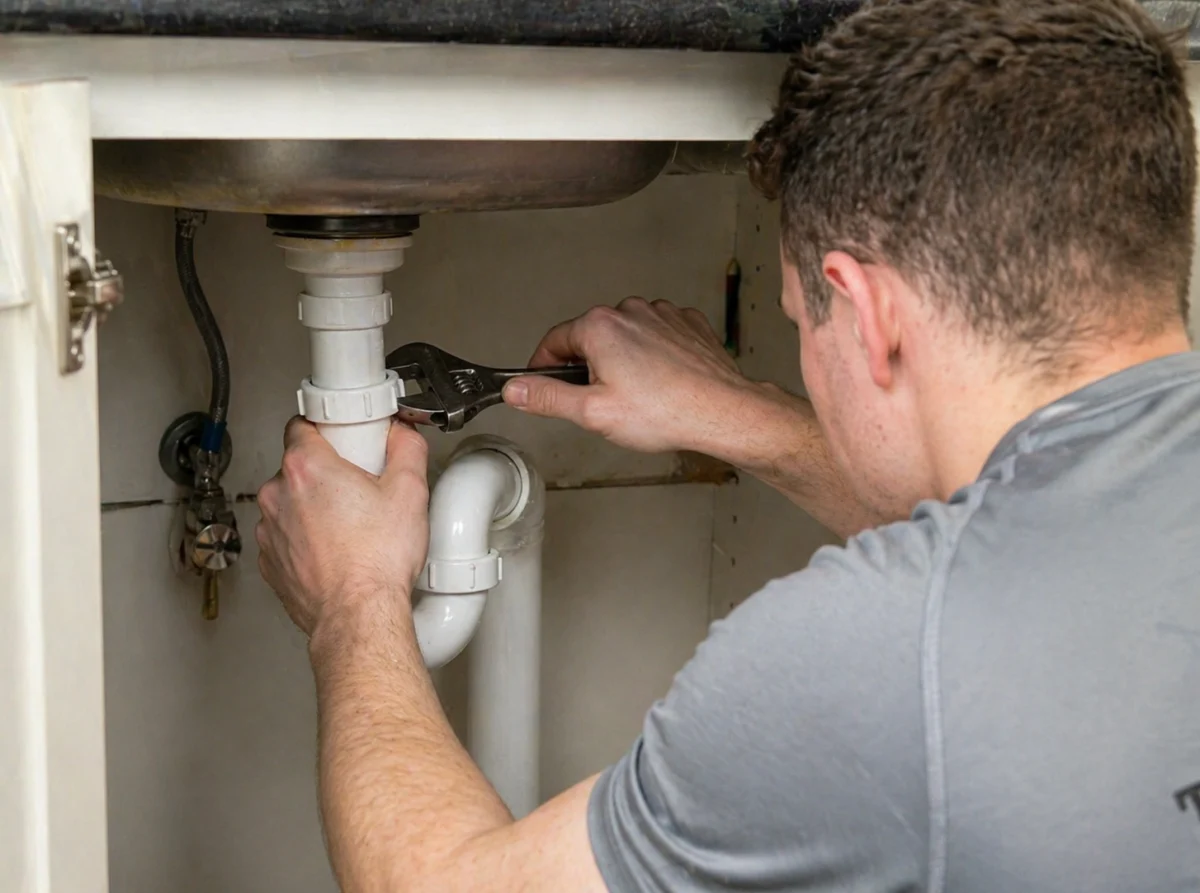

Modern kitchen plumbing is more complex than it was a decade or two ago. A typical Ealing kitchen has the cold mains, hot supply, drinking water filter, dishwasher cold supply, washing machine cold supply, waste disposal feed, and sometimes a fridge water line all routed through the under-sink cabinet. Add in a boiling-water tap with its under-sink tank, or a reverse-osmosis filter system, and the under-sink space becomes seriously crowded.
The under-sink cabinet is also where things go wrong: the most common kitchen plumbing problems are leaks at the multiple compression joints, blocked traps from food waste, perished flexi hoses on appliance feeds, failed isolation valves, and water staining at the cabinet base from years of slow weeps.
Proper kitchen plumbing means accessible isolators on every supply (so any single appliance can be turned off without affecting the others), correctly routed waste pipework with the right falls (no flat runs, no upward kinks), enough cabinet space left for future service access, and modern materials throughout (push-fit plastic for hidden runs, copper for visible plant-room style routing if preferred).
Replacing a kitchen sink looks straightforward but has more variables than people expect. Sink type, worktop type, tap configuration, waste arrangement, dishwasher connection, possible waste-disposal unit — they all interact.
Sink types in modern Ealing kitchens: stainless steel inset (still the most common, fitted into a worktop cutout), composite granite or quartz (heavier, similarly inset), undermount (sink fixed beneath the worktop, no rim visible — cleaner look but limited to solid worktops), Belfast or Butler (large ceramic farmhouse sinks, sit on a dedicated cabinet base), and integrated (single piece with the worktop). Each has different installation considerations.
Step 1: Existing services check. Cold supply, hot supply, waste outlet position, isolators present or not, dishwasher cold tee already in place. Many older Ealing kitchens have minimal isolation — Clive fits new isolators as part of every sink install regardless.
Step 2: Remove existing. Old sink unsealed from worktop or removed from undermount fixings. Disconnect taps and wastes. Clean cutout edge of old sealant. Sometimes the cutout itself needs adjustment if the new sink has different dimensions.
Step 3: New sink positioning. Inset sinks lowered into the cutout, undermount sinks suspended on cabinet rails, Belfast sinks placed on the cabinet shelf. Levelling checked across the rim. New sealant applied at the rim-to-worktop joint.
Step 4: Tap fitting. New tap (or refitted existing) installed through the tap hole. Back-nut tightened from below. Hot and cold tails connected to the existing supplies via fresh compression olives or push-fit fittings.
Step 5: Waste fitting. Strainer waste fitted to the sink outlet with new sealing washers. Trap (P-trap or U-bend) fitted with appropriate connections to the existing waste pipe. Any dishwasher waste connection routed correctly with rise-and-fall geometry.
Step 6: Test. Cold and hot turned on, sink filled and emptied to test waste flow. Dishwasher waste tested if connected. Watching for leaks at every joint.
Step 7: Walk-through. Cleaning advice for the new sink material (stainless, composite and ceramic each have different care). Sealant cure-time noted (24 hours typical before heavy use).
Typical cost. £180–£260 fitted for a like-for-like inset sink swap. £280–£420 for undermount. £350–£550 for Belfast/Butler installations (cabinet adjustment usually needed). Tap fitting separate (£85–£140) unless reusing existing.
Standard kitchen mixer. Single-lever or twin-lever mixer with a fixed or pull-out spray spout. Most popular kitchen tap by far. Single tap hole, single body, hot/cold blending at the spout. £85–£140 fitted depending on whether new isolators are needed.
Pull-out spray mixers. Mixer with a detachable spray head on a flexible hose. Useful for filling tall pots and rinsing oversized cookware. Slightly more involved install (the hose passes through a counterweight assembly under the sink). £100–£160 fitted.
High-arc gooseneck mixers. Tall, sweeping spout for tall vessels. Visual statement. Same install as standard mixers but the tap itself is more expensive.
Bridge mixers (period style). Separate hot and cold handles flanking a central spout, typically deck-mounted via three holes. Suit traditional Belfast/Butler sinks and period kitchens. £140–£220 fitted (3-hole installation is more involved).
Boiling-water taps (Quooker, Fohën, InSinkErator, Grohe Red). Instant kettle-hot water on demand from a small under-sink tank. Need a 13A power socket under the sink, cold mains feed, and 25–35cm of cabinet depth for the tank. Safety lock as standard on most modern units. £220–£420 fitted plus the unit and tank. Coordinated with electrician for the under-sink socket if not already present.
Filtered-water taps. Separate small tap mounted alongside the main mixer, fed from an inline carbon filter under the sink. Filter cartridge replacement every 6–12 months. £180–£280 fitted plus filter and cartridge.
Carbonated-water taps (Grohe Blue, BWT). Sparkling water on demand from a CO₂ canister system. Most demanding installation — under-sink space for canister, filter, chiller, pump. £280–£480 fitted plus the unit.
Reverse-osmosis filtration. Multi-stage water purification with a small storage tank. For households wanting drinking water free of dissolved solids, chlorine, and most contaminants. Significant under-sink space required. £380–£650 fitted plus the system.


Waste disposal units (also called food waste disposers or grinders) are increasingly common in Ealing kitchens — particularly in renovations where reducing food waste in council bins is a priority. They sit under the sink, replacing the standard waste outlet, and grind food scraps into fine particles that flush down the drain.
What they need. A 13A switched power supply (usually a wall switch above the worktop with a flex down to the unit), the cold mains feed (running cold water flushes the unit during operation), and a dedicated waste outlet with a trap. Most modern kitchens with new mixer taps fed from below have all of these already; older kitchens often need a new socket and switch installed.
Installation. Sink waste outlet replaced with a unit-specific mounting flange. Disposal motor unit suspended below the sink on the flange — they're heavy (typically 4–6kg) so a robust mount is essential. Power cable run to the switch position. Cold supply teed in if a separate disposal-flush valve is used. Drain pipework re-routed below the unit with the trap downstream.
Operation walk-through. Continuous-feed vs batch-feed models work differently — Clive walks through how to use whichever model is being installed. Run cold water before, during and 15 seconds after grinding. What goes in (most food waste, fish bones up to a certain size, fruit and vegetable peelings) and what doesn't (fibrous waste like celery and corn husks, large bones, fats and oils).
Maintenance. Periodic flushing with ice cubes and citrus peel keeps the grinding chamber clean. Reset button location shown — most units have an overload cut-out that needs manual reset if jammed.
Typical cost. £180–£280 fitted for the disposal install on existing services, plus the unit itself. £80–£140 added if a new under-sink switched socket is needed (coordinated with electrician).
A kitchen refit involves multiple trades on a tight schedule — kitchen fitter, plumber, electrician, sometimes tiler, possibly gas engineer for hob/oven gas connection. The sequence and coordination matter as much as the individual workmanship.
First-fix plumbing is the structural pipework laid out before the kitchen units go in. Fresh hot and cold supply runs to the planned tap and appliance positions, fresh waste pipework with correct falls, fresh isolators on every branch, capped ends ready to connect once the kitchen is built. First-fix is signed off before the kitchen fitter starts so the fitter knows where every pipe terminates.
Second-fix plumbing is the connection of fixtures and appliances after the kitchen units, worktops and tiles are in place. Sink and taps connected to the first-fix tails, dishwasher and washing machine plumbed in, waste disposal unit fitted if specified, boiling-water tap with under-sink tank installed, fridge water-line run to its position. All leak-tested under live pressure.
Coordination with the kitchen fitter. Clive works with the fitter's planned schedule — first-fix typically slots in after the floor is down and before the units go in (1–2 day window), second-fix slots in after worktops are cut and before the kitchen is ‘handed back’ (1 day window). Communication on the day matters: knowing if the fitter has changed any unit positions, whether the worktop overhang has changed how the tap will sit, whether the dishwasher cabinet has shifted by 50mm.
Coordination with the electrician. NICEIC-registered electrician handles all the wiring — sockets above worktops, oven and hob power, lighting, extractor connection. Plumbing and electrical work often interleave on the same day during second-fix. Clive's regular electrician colleagues know the sequence and how to share an under-sink cabinet.
Coordination with the gas engineer. If a new gas hob is being installed (or moved), the gas connection is Gas Safe registered work. Clive isn't Gas Safe registered, so David handles that part — typically a 1–2 hour visit during second-fix to make and test the new gas connection. You don't pay extra for the coordination; it's just part of how a kitchen refit is properly run.
Documentation. Plumbing certificate covering the first-fix and second-fix work. Manufacturer warranties registered for any specialty taps and appliances. Service-access notes provided so future work doesn't surprise you.

£180–£260 for a like-for-like inset sink swap including new sealant, new strainer waste, and a fresh trap. £280–£420 for undermount installations (heavier sink, more support work). £350–£550 for Belfast/Butler farmhouse sinks (cabinet adjustment usually needed). Tap fitting is separate at £85–£140 unless you're reusing the existing tap. All quoted as fixed prices, no hourly billing. Other plumbing work Clive covers from the same Ealing base: emergency plumbing, drain unblocking, pipework and repipes, tap and outlet installation, water tank installation, leak detection, toilet installation, white goods plumbing, radiator installation, hot water cylinder installation and bathroom installation.
Yes — first-fix pipework before the units go in, second-fix fixtures and appliances after. Coordinated with whoever's fitting the kitchen and with the electrician for any wiring elements. Quoted as a fixed price for the full plumbing scope after a survey visit. Typical kitchen refit plumbing scope is £1,200–£2,500 depending on number of appliances and any specialty taps.
Most clients supply their own — Ealing has plenty of kitchen showrooms and online retailers offering competitive prices. Clive's quote is the labour and any small materials needed (sealant, isolators, fresh compression olives, fixings). Bring everything to the appointment with manuals. Phone before ordering if you're not sure whether a particular sink or tap suits your existing setup. Gas-side services David also handles: boiler installation, boiler servicing, boiler repair, central heating installation, central heating repair, gas safety checks, gas leak detection, gas cooker installation, gas fire servicing and power flushing — all Gas Safe registered, all run from the same Ealing base.
Gas connections are Gas Safe registered work and Clive isn't Gas Safe registered — that part is David's domain. On refit projects David is brought in to make and test any new gas hob connection during second-fix, typically a 1–2 hour visit. You don't pay extra for the coordination; it's part of how a kitchen refit is properly run. Boiling water taps and induction hobs don't involve gas and are fully within Clive's scope. Other plumbing work Clive covers from the same Ealing base: emergency plumbing, drain unblocking, leak detection, toilet installation, radiator installation, hot water cylinder installation and bathroom installation.
2–4 hours typical including under-sink tank fitting, cold supply connection, tap fitting, electrical socket coordination if needed, commissioning to manufacturer specs and walk-through of the safety controls. Some installations take longer if cabinet adjustments are needed to fit the tank, or if a new 13A socket needs to be added under the sink. Quoted on survey for accurate timing.
+
%
+
%

For kitchen plumbing work anywhere in kitchen plumbing in Ealing, kitchen plumbing in Acton, kitchen plumbing in Hanwell, kitchen plumbing in Greenford, Northolt, Perivale, Southall, kitchen plumbing in West Ealing, Park Royal, kitchen plumbing in Pitshanger, Brentham, North Ealing, kitchen plumbing in South Ealing or anywhere else across the W postcodes — phone Clive directly on 07794 400 786.
Clive also covers kitchen plumbing across the rest of the borough — kitchen plumbing in Boston Manor, kitchen plumbing in Brentford, kitchen plumbing in Ealing Common and kitchen plumbing in Northfields — all served from the same Ealing base, same engineer, same fixed-price quotes.
Single-fixture jobs (sink swap, tap install, waste disposal fit) booked within a few days. Full kitchen refit plumbing coordinated with the kitchen fitter's schedule. 12-month workmanship warranty on every install.