


Older Ealing properties — particularly Edwardian, Victorian and pre-1990s build — frequently have vented plumbing systems with cold water storage tanks in the loft. The cold mains feeds a tank in the loft, the tank gravity-feeds the hot water cylinder and the upstairs cold taps. Modern combi-boiler properties don't have these tanks; modern unvented properties have a single sealed cylinder with no loft tank. But thousands of properties in Ealing still operate on the older vented setup.
That's not necessarily a problem — vented systems work, and converting them to combi or unvented is a major project (£3,500+). The issue is that loft tanks need active maintenance and don't last forever. Original galvanised steel tanks installed in the 1960s and 1970s are now 50+ years old and well past design life. Original plastic tanks from the 1980s often pre-date current WRAS approval standards. Lids fall off, overflow pipes block, ball valves seize, insulation degrades, vermin get in.
The fix isn't always replacement — sometimes a tank just needs a new ball valve, fresh insulation, a proper lid and a byelaw 30 kit fitted. Sometimes it does need full replacement to current standards. Clive surveys first and recommends honestly.
Vented plumbing systems involve different tanks doing different jobs. Knowing which tank does what helps you describe the problem and helps Clive bring the right parts.
Cold water storage tank (loft). The big one — typically 50–230 litres in plastic or galvanised steel, sitting on bearers across the loft joists. Fed from the cold mains via a ball valve; gravity-feeds the hot water cylinder, the cold supply to upstairs basins and toilets, and (in older properties) sometimes the cold supply to bath taps too. Common faults: leaking ball valves, perished tank base where it sits on bearers, displaced lid letting dust and vermin in, missing or perished byelaw 30 kit (the kit that prevents stored water becoming a contamination risk to the mains).
F&E (feed-and-expansion) tank (loft). Smaller — typically 25–50 litres — and serving only the central heating circuit. Sits in the loft alongside or on top of the larger cold storage tank. Feeds the heating circuit with cold water as needed (when the system loses pressure or is being topped up) and accommodates the heated water's volume expansion. Common faults: ball valve leaking, overflow running into the loft because the ball valve has stuck open, contaminated water (sludge from the heating system back-feeding into the tank), tank itself perished.
Hot water cylinder (airing cupboard). Stores hot water — copper or steel, vented (open to atmosphere via the loft tank) or unvented (sealed, mains-pressure). The vented type is what gravity-fed systems use. Common faults: leaking immersion heater, leaking thermostat pocket, internal coil failure (no longer transferring heat from boiler to stored water), perished cylinder body. Replacement is more involved than tank work — often part of a system upgrade.
Expansion vessel (sealed system). Different beast — a small steel vessel with an internal diaphragm, used on sealed (combi or unvented) systems to accommodate water expansion. Located inside the boiler casing on most modern combis or as a separate unit on unvented installations. Common fault: diaphragm failure causing pressure fluctuations and PRV discharge. Re-pressurisation is a service-time job; replacement is straightforward.
Water softener brine tank. Plastic tank holding salt-saturated brine for ion-exchange water softeners. Common faults: salt bridging (salt fusing into a solid block above the water), leaking float valve, dirty brine. Most softener-tank work is part of softener servicing rather than a standalone job.
Ball valve replacement — the most common loft tank repair. Old ball valves seize, the float arm perishes, or the seat erodes letting water through even when shut. New brass-bodied Part 1 or Part 2 valve fitted with a new float and securing nuts. £85–£140 fitted depending on accessibility.
Overflow pipe rectification — overflow continuously dripping or running externally because the ball valve has stuck open or the water level is set wrong. Sometimes the overflow itself is blocked by debris from a poor tank lid. £60–£120 typical.
Tank lid replacement — old wooden lid rotted, plastic lid cracked or warped, or just missing entirely. Modern WRAS-compliant rigid plastic lid fitted with insect-proof breathers. £45–£85 supplied and fitted.
Insulation renewal — old jacket insulation perished or sodden. New rigid foam or jacket insulation around the tank reduces heat loss in winter and condensation in summer. £80–£140 typical.
Byelaw 30 kit retrofit — older tanks often don't have the current WRAS-required protection (insect-proof vent, debris-proof inlet/outlet, secure lid with backflow protection). Retrofit kit £45–£90 fitted.
Tank-to-bearer rectification — old galvanised tanks rusting at the base where they sit on bearers, or plastic tanks bowing under unsupported weight. Bearers replaced or repositioned, full-base support provided. £80–£180 depending on tank size.
Service valve fitting — older tanks often don't have an isolation valve on the cold feed. Adding one means the tank can be isolated for maintenance without major mains shutdown. £80–£120 fitted.

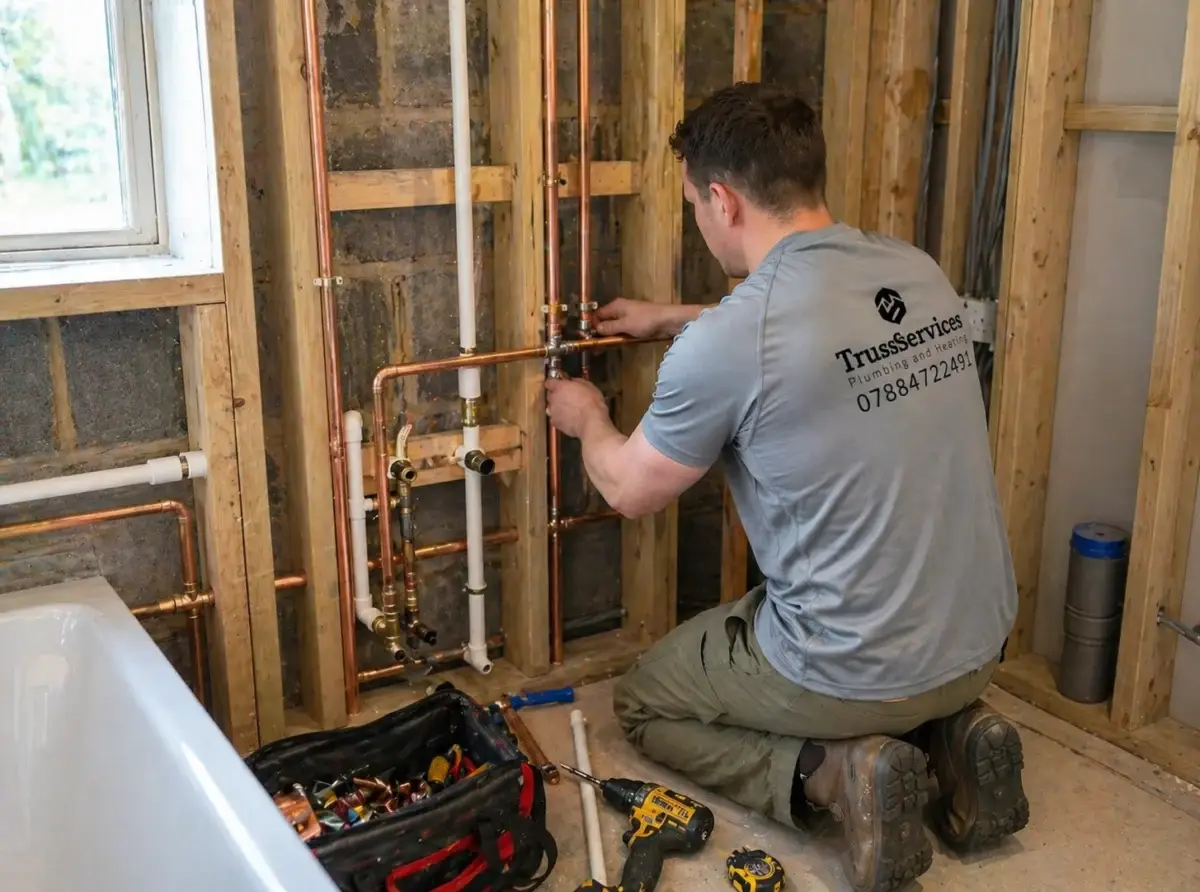
Replacing a loft tank is a bigger job than a service but smaller than full system replacement. Here's how Clive runs through a typical tank swap on an Ealing semi.
Step 1: Survey. Existing tank type and dimensions checked, access route confirmed (loft hatch size, how to get the new tank up there), pipework connections noted, position on bearers verified. Decisions made on whether bearers need replacement (often yes — original timbers may be 50+ years old).
Step 2: System isolation. Cold mains isolated at the under-sink stopcock. All cold and hot taps run until empty. Hot water cylinder drained if it's connected via the same tank. Heating system isolated if the F&E tank is also being replaced.
Step 3: Old tank removal. Tank fully drained — sometimes via the existing outlet, sometimes by cutting the outlet and letting it run to a temporary drain hose. Old pipework disconnected at the tank. Tank lifted out (galvanised tanks are heavy — usually requires two people for the larger sizes). Lid, jacket and any debris removed from the loft.
Step 4: New tank positioning. Bearers replaced or re-leveled if needed. New WRAS-approved plastic tank lifted into position. Most modern tanks are PE (polyethylene) — lighter than galvanised, won't rust, 25-year manufacturer warranty.
Step 5: Pipework reconnection. Cold inlet connected to the new ball valve. Cold outlet connected to the existing supply. Overflow pipe routed to the original termination point (typically through the eaves to outside). Any byelaw 30 kit fitted.
Step 6: Insulation. Rigid foam insulation around the tank body. Lid fitted with insect-proof breathers. Any pipework in the loft jacketed with foam-tube insulation.
Step 7: Refill, vent and test. Cold mains restored, tank fills, system progressively refilled at all hot and cold draw-off points. Air vented from cylinder and from highest points of the system. Full pressure test, full flow check at every fixture.
Step 8: Documentation. Tank details (manufacturer, model, capacity, fit date) logged for future reference. Any byelaw-related work documented. Manufacturer warranty registered if applicable.
Typical scope is a 1-day job for cold storage tank replacement, sometimes 1.5 days if the F&E tank is also being replaced. £550–£950 typical including tank, materials and labour.
If you're scoping tank replacement and the rest of the system is also reaching end of life, it's worth thinking about whether to keep the vented setup at all or convert to a modern combi or unvented system.
Stay with vented + replace tank (£550–£950). Cheapest option. Suits properties where the existing setup works well, hot water demand is modest, and you don't mind the loft-tank arrangement. Tanks last 25+ years; cylinder may also need attention but that's a separate job.
Convert to combi (£3,500–£6,500). Removes loft tanks entirely, removes cylinder, removes airing cupboard wet space. New combi boiler provides hot and cold mains-pressure. Suits 1–3 bed properties with good mains pressure and modest hot water demand. Significant gas-side work — David handles that part.
Convert to unvented (£3,500–£8,000). Removes loft tanks but keeps a cylinder (now unvented, mains-pressure). New system boiler heats the cylinder. Suits multi-bathroom properties where stored hot water at mains pressure is the right answer. Gas-side commissioning by David.
Decision factors include: number of bathrooms, household size, mains water pressure, current system age, planned loft conversion, and willingness to lose the airing cupboard. Clive walks through the options on a survey visit and quotes the relevant scope.

£550–£950 typical for cold water storage tank replacement including the new WRAS-approved tank, bearers, insulation, lid, byelaw 30 kit, all pipework reconnection, and a full system test. F&E tank replacement on its own is £280–£420. Doing both at the same time is around £700–£1,100. Single-component repairs (ball valve, lid, insulation) are £45–£140. Always quoted in writing after a survey.
1 working day for a cold water storage tank swap. 1–1.5 days if the F&E tank is also being replaced. Most of the day is preparation and testing rather than the actual physical swap — the new tank goes in within the first hour or two. The water is off in the property for 4–6 hours mid-job; Clive coordinates timing so it's during a manageable window.
Yes — water byelaws require it for any tank installed since 1999, and it's good practice for any replacement regardless. WRAS approval covers material safety (no leaching of contaminants into stored water), construction quality (joint seal integrity, dimensional accuracy), and byelaw 30 protection (insect-proof breathers, debris-proof inlet/outlet, lid security). Non-WRAS tanks are progressively being phased out as old units fail.
Maybe — depends on your property and household. Combi removes the loft tanks entirely, removes the cylinder, frees up the airing cupboard, and gives mains-pressure hot water. Trade-offs: higher upfront cost (£3,500–£6,500 vs £550–£950 for tank replacement), reliance on combi mains pressure for showers, and gas-side work (which means coordinating David). For 1–3 bed properties with one bathroom, combi often makes sense. For larger properties with multiple bathrooms, system-with-unvented-cylinder is usually a better answer. The full gas-side service list David covers: boiler installation, boiler servicing, boiler repair, central heating installation, central heating repair, gas safety checks, gas leak detection, gas cooker installation, gas fire servicing and power flushing — all Gas Safe registered, all run from the same Ealing base.
That's an emergency — phone direct on 07794 400 786. Holding actions while Clive is en route: turn off the cold mains stopcock (under-sink in most Ealing properties), open the lowest cold tap to drain the system as fast as possible, get any saggable ceiling weight off (don't pierce a bulging ceiling — let it weep through existing cracks). Once Clive arrives the tank is isolated, the leak source identified, and emergency repair carried out. Sometimes a temporary fix on the same visit and full replacement scheduled for a follow-up. Other plumbing work Clive covers from the same Ealing base: emergency plumbing, drain unblocking, pipework and repipes, tap and outlet installation, toilet installation, white goods plumbing, kitchen plumbing, radiator installation and bathroom installation.
+
%
+
%

For loft tank, F&E tank and storage cylinder work anywhere in water tank installation in Ealing, water tank installation in Acton, water tank installation in Hanwell, water tank installation in Greenford, Northolt, Perivale, Southall, water tank installation in West Ealing, Park Royal, water tank installation in Pitshanger, Brentham, North Ealing, water tank installation in South Ealing or anywhere else across the W postcodes — phone Clive directly on 07794 400 786.
Clive also covers water tank installation across the rest of the borough — water tank installation in Boston Manor, water tank installation in Brentford, water tank installation in Ealing Common and water tank installation in Northfields — all served from the same Ealing base, same engineer, same fixed-price quotes.
Older Ealing properties with vented systems are Clive's regular territory. He knows what's likely to be in your loft before he opens the hatch — galvanised tanks, perished bearers, missing byelaw 30 protection, sodden insulation. Survey, honest assessment, written quote covering whatever scope makes sense.